
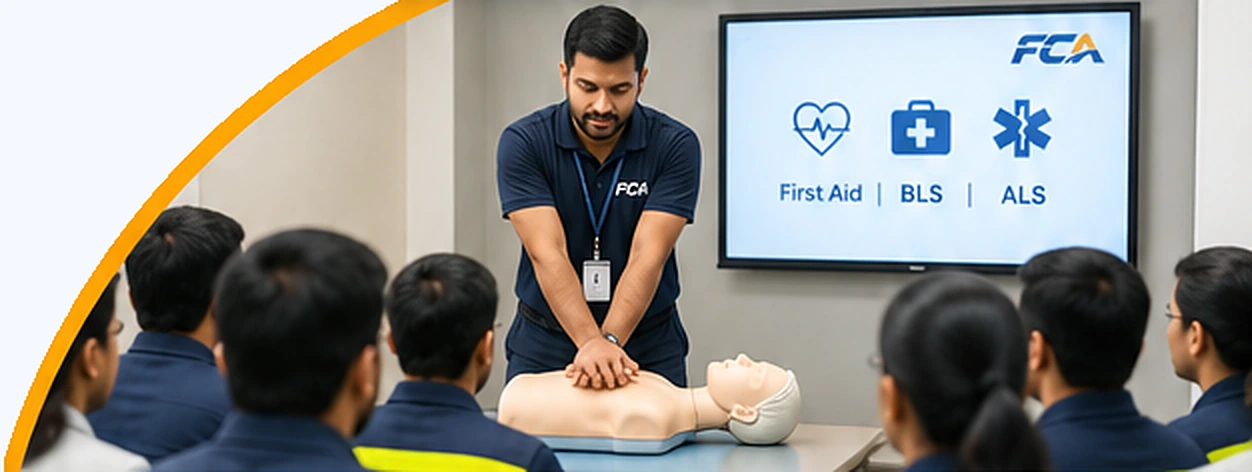
Ambulance Driver and EMT Training
First Aid, BLS and ALS training that gets your teams genuinely response-ready.
FCA runs First Aid, BLS and ALS programmes, along with ambulance driver and EMT training, for hospitals, corporate teams and industrial sites. Batches are held on-site and scheduled around your shifts. Our Indore desk keeps certification records and plans refreshers. Call +91 77469 38622 or send the enquiry form to get a proposal.
Published by Fleet Care Assist 24x7 · Last updated
The challenge
The problem we solve.
Corporate, healthcare and industrial teams are often first on scene in an emergency but rarely trained for it.
Best for
Healthcare Mobility
What FCA does
- First Aid training for corporate and industrial teams
- BLS (Basic Life Support) certification programmes
- ALS (Advanced Life Support) training for healthcare staff
- On-site batches scheduled around your operations
- Refresher programmes to keep certification current
- Assessment and certification tracking
Who it's for
Who uses training & certification
Hospitals and ambulance operators
- BLS and ALS refreshers for ambulance crew and ward staff.
- Orientation for newly hired ambulance drivers and EMTs.
- Certification tracking so no crew member works with a lapsed card.
Factories and industrial sites
- First Aid training for shift supervisors and safety teams.
- BLS and AED practice for the site first-response team.
- Refresher batches timed with safety audits and mock drills.
Corporate offices and campuses
- First Aid and CPR skills for floor wardens and front-desk staff.
- BLS batches for the in-house emergency response team.
- Short sessions during working hours with little disruption.
Options
| Option | What it covers | Suits |
|---|---|---|
| First Aid | Bleeding control, wounds, burns, fractures, choking and when to call for help | Corporate staff, industrial workers |
| BLS (Basic Life Support) | CPR, AED use, choking response and team roles in a cardiac emergency | First responders, ambulance crew, nurses |
| ALS (Advanced Life Support) | Airway management, IV therapy and advanced emergency care, built on BLS | Ambulance crew and healthcare staff |
| Ambulance driver and EMT orientation | Patient handling, vehicle and equipment checks, and safe driving with a patient on board | New ambulance drivers and EMTs |
| Refresher programme | Repeat practice and reassessment before certification lapses | Teams already trained |
Training programmes
Deliverables
What you get.
Training schedule
Certification records
Refresher plan
Our process
How it works.
Step 1: Enquiry
Tell us who needs training, how many people, which programme and where. We suggest a programme based on each group's role.
Step 2: Assessment
We check existing certification dates, agree batch sizes and a schedule around your shifts, and confirm the room and equipment needed on site.
Step 3: Deployment
Trainers run hands-on sessions at your facility. Participants are assessed on practical skills, not only attendance.
Step 4: Monitoring
Certification dates for every participant are logged so upcoming expiries are visible well in advance.
Step 5: Reporting
You receive attendance, assessment results and certification records, plus a refresher plan for the next cycle.
Coverage
Coordinated 24×7 from FCA's desk in Indore, Madhya Pradesh, with a verified partner network for work in other states. See training & certification in Indore or multi-state operations.
Compliance and standards
- Your proposal names the issuing body and certificate type for each programme before the batch starts.
- Certification expiry dates are tracked for each participant so refresher batches are scheduled before cards lapse.
- Practical skills are assessed hands-on, so records show what each person can do, not only that they attended.
Why FCA
- Training draws on FCA's own ambulance and fleet operations, led by founder Mahendra Singh Meena with 12+ years in ambulance management and healthcare mobility.
- On-site batches are planned by the 24x7 Indore desk, which also tracks refresher dates.
- GST and Udyam (MSME) registered, for simple hospital, corporate and PSU procurement.
FAQs
Common questions about training & certification
What is the difference between BLS and ALS training?
BLS (Basic Life Support) covers CPR, AED use and choking response — suitable for all corporate and industrial first responders. ALS (Advanced Life Support) adds airway management and IV therapy, designed for ambulance crew and healthcare staff.
Can FCA conduct First Aid or BLS training at our workplace?
Yes. We run on-site batches at your facility, scheduled around your operations. Training is hands-on and practical, and we provide certification records and refresher scheduling on completion.
How often should teams be refreshed on BLS certification?
The American Heart Association and most Indian healthcare protocols recommend BLS recertification every two years. FCA tracks certification expiry and proactively schedules refresher batches before teams lapse.
What qualifications and training does an ambulance driver or EMT need?
An ambulance driver needs a valid driving licence for the vehicle class, plus training in patient handling, equipment checks and safe driving with a patient on board. An EMT needs formal emergency medical training, and BLS is the baseline life-support skill for every crew member. Exact requirements vary by employer and contract, so check your tender or hospital policy; FCA can align training to it.
Who issues the certificate after a First Aid or BLS batch?
The issuing body depends on the programme you choose, and we confirm it in writing before the batch starts. Your certification records list each participant, the programme, the date and the expiry. Ask us for the certificate format when you request a proposal. If you need a particular certification for a tender or accreditation, tell us at the enquiry stage.
How many people can attend one batch?
Batch size is set so every participant gets enough hands-on practice time. We agree the number with you during planning, based on the programme and the practice equipment available. Large teams are split into several batches across shifts.
Is First Aid training enough for a factory first-response team?
First Aid alone does not cover cardiac arrest, which needs the CPR and AED skills taught in BLS. For a site first-response team, First Aid plus BLS is the stronger combination. Your safety officer and any applicable factory rules set the minimum.
Can training be scheduled with our safety audit or mock drill?
Yes. Holding a refresher close to a safety audit or emergency drill keeps skills fresh when they are tested. We plan batches around your audit calendar and share records in the format your safety team needs. Records from each batch can be filed with your audit evidence.
What decides the cost of a training programme?
Cost depends on the programme, the number of participants and batches, the location and any certificate fees. On-site batches at one location cost less per person than scattered sessions. We quote once the scope is agreed.
Need training & certification?
Tell us your fleet size, cities and what you need. We reply with a written quote.
Get a quote